 🐱 Cat Mystery
The short answer
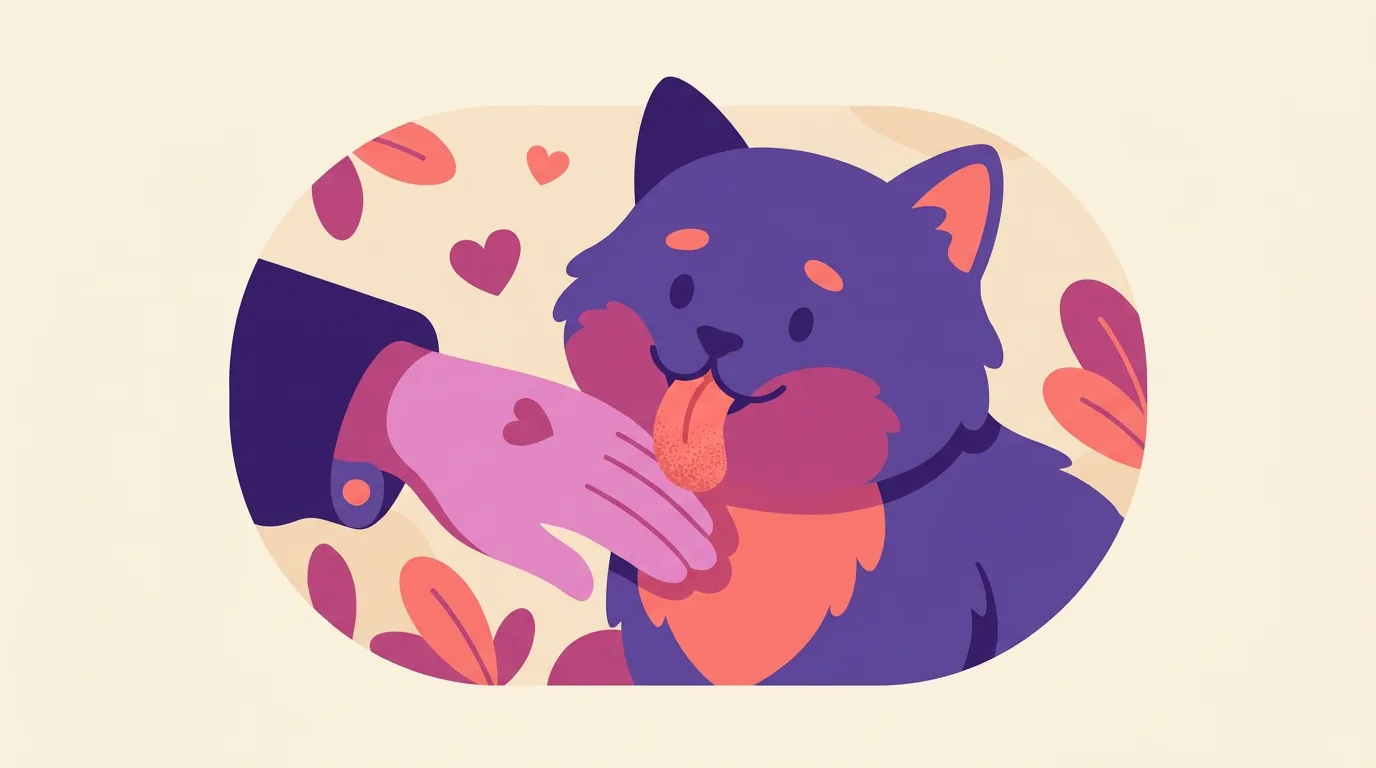
Cats lick you to groom you as part of their family (“allogrooming”), to mark you with their scent, and to show trust and affection. That rough tongue is one of the biggest compliments a cat can give.
A cat's tongue feels like wet sandpaper because it is covered in backward-facing keratin spines called papillae — the same structures that let a cat strip meat from bone and drag saliva down to the skin while grooming. When that tongue lands on your arm, you are being handled with a tool built for cleaning another cat. That is the whole point.
Licking is a social act, not a hygiene one
Cats groom themselves constantly and efficiently. When a cat grooms someone else — another cat, or you — it is doing something different, called allogrooming, and it is one of the few behaviours in the feline repertoire that exists purely to manage relationships.
Free-living cats do not allogroom indiscriminately. Research on feline social structure finds it concentrated within stable groups, and directed most often at the head and neck: the areas an individual cannot reach alone. The behaviour clusters heavily among cats that are related or that have lived together a long time. It is a marker of an established relationship rather than a way to start one.
The four things your cat is doing when they lick you
- 1Including you in the group scent. Cats identify group members by a shared smell built from grooming, rubbing and sleeping in contact. Licking you deposits your cat's scent and picks up yours. You are being merged into the profile.
- 2Signalling an existing bond. Allogrooming is directed at established companions, not strangers. A cat that grooms you has already categorised you as in-group.
- 3Self-soothing. Grooming is rhythmic and calming for the groomer. Cats often groom a person during the wind-down before sleep for the same reason they knead.
- 4Tasting something. Sometimes it is unglamorous. Salt from sweat, lotion, or the residue of whatever you last cooked will all draw a cat's tongue.
The part most articles get wrong
The standard line is that licking always means love. A 2026 study from Ghent University and the University of Lincoln put that under proper scrutiny. Researchers ran a citizen-science project across 53 two-cat households and analysed video of real allogrooming rather than relying on owner recall.
Two findings stand out. Seeking physical contact was followed by allogrooming in a large share of cases, which supports the bonding story. But a substantial minority of grooming bouts were followed by agonistic behaviour from the groomer — a threat display, a stiffening, a swat. Allogrooming, in other words, also functions to manage tension: sometimes appeasement, sometimes a low-grade assertion of status.
Applied to you, this does not mean your cat is being hostile. It means licking is relationship-maintenance rather than a simple affection button, and it explains the pattern owners find so baffling — the lick that turns, without obvious warning, into a bite.
Why the lick becomes a bite
Two mechanisms overlap. The first is grooming escalation: cats groom each other with teeth as well as tongue, and small nibbles are a normal part of the sequence between cats. Your skin simply registers it differently than fur does.
The second is overstimulation. Repetitive contact builds arousal, and past a threshold a relaxed cat flips to irritated. Veterinary behaviour resources describe this as petting-induced aggression, and it is one of the most common feline behaviour complaints. The cat is not being unpredictable — the warning signs are just quiet.
Read the three-second warning
Before almost every bite there is a tell: the tail starts lashing or thumping, the skin along the back twitches, the ears rotate backward or flatten, and the pupils widen. Stop stroking at the first of these, not the last. Let the cat stay on you — ending the contact, not the closeness, is what resets things.
When licking becomes too much
Occasional grooming is normal. Licking that is relentless, hard enough to break skin, or paired with the cat over-grooming its own coat is worth attention. Compulsive grooming in cats is commonly driven by stress, pain, or skin disease, and it tends to appear alongside other changes: hiding, litter box avoidance, appetite shifts, bald patches on the belly or flanks.
The usual practical causes of a stress spike are unremarkable and fixable — a house move, a new pet or baby, building work, a change in feeding routine, or a resource shortage in a multi-cat home. The standard guidance is one litter tray per cat plus one spare, separated feeding stations, and enough vertical space for cats to avoid each other without confrontation.
Worth a vet appointment
Book a check if the licking is new and intense, if your cat is grooming itself bald, if there are scabs or hair loss, or if the behaviour arrived alongside weight loss, increased thirst, or night-time yowling. Compulsive grooming is frequently a pain or skin-disease signal rather than a behavioural quirk, and it is far easier to treat early.
Should you let your cat lick you?
For most people, yes. Cat saliva on intact skin is a low risk for a healthy adult. Wash the area if you are about to eat, avoid letting a cat lick broken skin, and be more cautious if you are immunosuppressed, pregnant, or very young or old — in those cases the sensible move is to redirect rather than accept.
Redirecting works better than refusing. Offer a hand to groom instead of a face, or move a soft blanket under the cat and let them work on that. Pushing the cat away mid-groom sends the wrong signal about the one behaviour that reliably indicates they consider you family.
Gear that actually helps
Hand-picked for this behavior. We may earn a small commission — at no cost to you.
Frequently asked
Why does my cat lick me then bite me?
Two things overlap. Cats normally combine tongue and teeth when grooming each other, so light nibbling is part of the sequence. On top of that, repeated contact builds arousal until a relaxed cat becomes irritated — petting-induced aggression. Watch for tail lashing, skin twitching and ears rotating back, and stop before the bite.
Does my cat licking me really mean love?
It means an established social bond, which is close but not identical. A 2026 video study found allogrooming also functions to manage tension between cats, with a notable share of grooming bouts followed by threat behaviour. Treat it as relationship-maintenance rather than a pure affection signal.
Why is my cat's tongue so rough?
It is covered in backward-facing keratin spines called papillae, which act like a comb — stripping loose fur, moving saliva to the skin, and pulling meat from bone. They are built for grooming fur, which is why they feel abrasive on bare skin.
Is it safe to let my cat lick me?
For a healthy adult with intact skin, the risk is low. Avoid letting a cat lick open wounds or your face near the mouth and eyes, and wash before eating. If you are immunosuppressed or pregnant, redirect the grooming to a blanket instead.
Why does my cat lick my hair specifically?
Hair is the closest thing you have to fur, and heads and necks are exactly where cats direct allogrooming with each other. Hair products with tempting smells or salt from sweat make it more likely.
My cat licks me constantly — is that a problem?
Occasional grooming is normal; relentless licking is not. If it is new, intense, or paired with your cat over-grooming its own coat, hair loss, hiding or appetite change, get it checked. Compulsive grooming is often driven by stress, pain or skin disease.
Sources
Every claim on this page is checked against published veterinary and animal-behaviour research. Here’s where it comes from.
- 1Unravelling feline social dynamics — a video-based observational study on allogrooming in domestic cats — Van Belle et al., Applied Animal Behaviour Science (2026)
- 2Social organization in the cat: a modern understanding — Journal of Feline Medicine and Surgery (via PubMed Central)
- 3Influence of familiarity and relatedness on proximity and allogrooming in domestic cats — Curtis, Knowles & Crowell-Davis, via PubMed
- 4Cat Behavior Problems — Aggression — Petting Aggression — VCA Animal Hospitals
- 5Feline Behavior Problems: Aggression — Cornell Feline Health Center
Keep exploring
 🐱 Cat Mystery
Why Does My Cat Bite Me Then Lick Me? Love Bites, Decoded
One second they’re nibbling your hand, the next they’re grooming it. It’s not mixed signals — it’s a whole conversation. Here’s the translation.
Why Does My Cat Lick the Wall?
Tongue to the wall? It’s odd but common — and here’s how to tell harmless curiosity from a red flag.
Why Does My Cat Wink at Me? The Secret “I Love You”
When your cat slow-winks at you, they’re saying something sweet. Here’s how to read — and return — it.
 🐱 Cat Mystery
Why Does My Cat Lick My Hair? The Grooming Compliment
Waking up to a cat styling your hair with their tongue? It’s weird, it’s sweet, and it means more than you’d think.
Why Does My Cat Bite Me Gently? Love Bites, Decoded
A soft little nibble that doesn’t hurt? That’s your cat talking — and it’s usually sweet. Here’s the translation.
Why Does My Cat Lick Plastic Bags? The Strange Obsession
The crinkle, the smell, the lick — plastic bags are weirdly irresistible to cats. Here’s why, and when to worry.