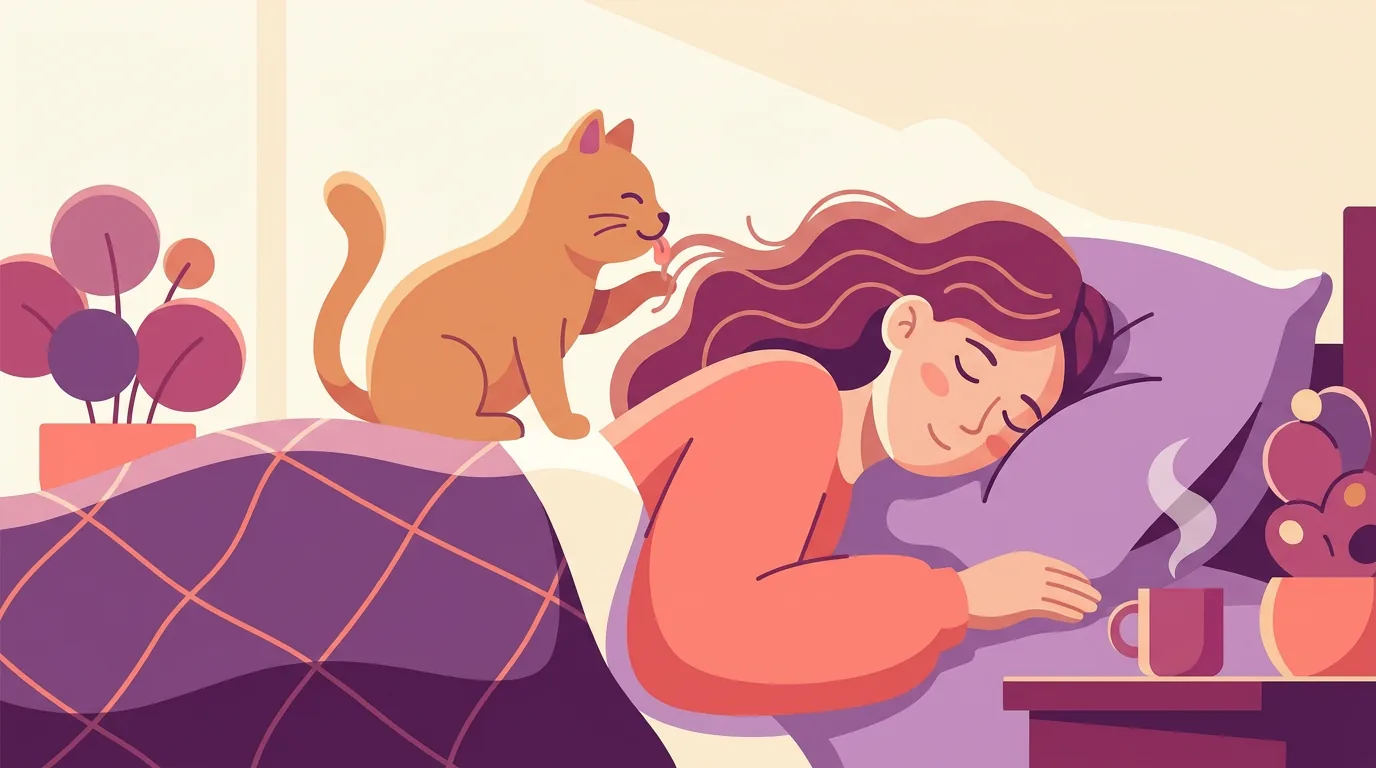
 🐱 Cat Mystery
The short answer
Your cat licks your hair to groom you as family (allogrooming), because it smells strongly of you (and of interesting hair products), and as a comforting bonding ritual. It’s a big sign of trust and affection.
Of everything on a person, hair is the closest thing a cat has to fur — and the head is exactly where cats direct grooming at each other. Hair-licking is not a quirk; it is the single most predictable target a cat would choose.
Cats groom heads and necks
Allogrooming — grooming directed at another individual rather than oneself — is one of the few feline behaviours that exists purely to manage relationships. Research on cat social structure finds it concentrated within stable groups and aimed overwhelmingly at the head and neck: the areas a cat cannot reach on itself.
Applied to a human, that means your hair. A cat licking, nibbling and working through your hair is running the same routine it would run on a companion cat, which is why the behaviour so often comes with the cat holding your head still with a paw.
What it means — with an important caveat
The standard interpretation is affection, and there is real support for it: allogrooming appears between cats that are related or have lived together a long time, rather than between strangers. A cat that grooms you has categorised you as in-group.
But a 2026 video study from Ghent University and the University of Lincoln complicated the simple version. Analysing real footage from 53 two-cat households, researchers found allogrooming was frequently followed by tension — threat displays, stiffening, a swat — in a substantial minority of cases. Grooming appears to manage relationships, including negotiating space and status, rather than purely celebrating them.
The practical implication is not that your cat dislikes you. It is that hair-grooming can tip into a nip without warning, and the sensible response is to read the rest of the cat rather than assume the licking will continue indefinitely.
The other reasons
- Scent exchange. Cats build group identity through shared smell. Grooming your hair deposits their scent and picks up yours — the same mechanism as cheek-rubbing.
- Your hair products. Coconut, shea, keratin and many conditioners smell interesting to cats, and some contain ingredients cats find genuinely attractive.
- Salt and oils. Scalp oils and sweat are palatable, particularly after exercise.
- Kitten behaviour retained. Cats weaned very early often suckle as well as lick, and hair is the most fur-like thing available. This frequently comes with kneading and drooling.
- Attention. If hair-grooming has ever produced stroking or conversation, it has been reinforced.
Watch the tail, not the tongue
Grooming that is about to turn into a bite telegraphs it: the tail starts to lash or thump, the skin along the back twitches, the ears rotate backward, and the pupils widen. Move your head away calmly at the first of those signals rather than the last. Going still and disengaging works far better than pulling away sharply, which triggers the grab reflex.
When it is worth attention
Occasional hair-grooming is normal. A few patterns are not.
Sucking rather than licking — particularly with rhythmic kneading and drooling — is usually harmless but occasionally signals a cat that is stressed or was weaned too early. It is worth mentioning to a vet if it is new or intensifying.
The more important pattern is compulsive grooming. A cat that grooms your hair relentlessly and also over-grooms its own coat — producing bald patches on the belly, flanks or inner legs — is showing a recognised sign of stress, pain or skin disease rather than affection. That combination needs investigating.
Cats also eat hair sometimes rather than just licking it. Persistent ingestion of non-food material is called pica, and while chewing a little hair is harmless, swallowing significant amounts risks gastrointestinal obstruction and warrants a conversation with your vet.
See a vet if
Your cat is over-grooming its own coat to the point of bald patches, scabs or hair loss; the grooming of you is new, relentless and hard to interrupt; your cat is swallowing hair rather than licking it; or the behaviour appeared alongside weight loss, increased thirst, appetite change or night-time vocalising. Compulsive grooming in cats is far more often driven by stress, pain or skin disease than by temperament.
If you would rather it stopped
Do not push the cat away mid-groom — you are rejecting the clearest signal it has that it considers you family, and most cats simply try again shortly afterwards.
Redirect instead. Offer a hand to groom, or slide a soft blanket between your head and the cat and let it work on that. Changing shampoo sometimes helps more than any behavioural approach, particularly with strongly scented products. And if it happens mainly at 5am, the underlying issue is the activity cycle rather than the grooming: a real play session and the largest meal of the day before bed shifts it far more reliably.
Gear that actually helps
Hand-picked for this behavior. We may earn a small commission — at no cost to you.
Frequently asked
Why does my cat lick my hair?
Hair is the closest thing you have to fur, and cats direct grooming at heads and necks — the areas another cat cannot reach alone. It is the same allogrooming routine they perform on companion cats, which is why it often comes with a paw holding your head still.
Does my cat licking my hair mean it loves me?
It indicates an established social bond — allogrooming appears between related or long-cohabiting cats rather than strangers. A 2026 study complicates the simple reading though: grooming also manages tension, so it can tip into a nip.
Why does my cat bite my hair while licking it?
Cats groom with teeth and tongue together, so nibbling is part of the normal sequence. Overstimulation can also tip a relaxed cat into irritation. Watch for a lashing tail, twitching back skin, ears rotating back and widening pupils, and disengage at the first sign.
Is it my shampoo?
Possibly. Coconut, shea, keratin and many conditioners smell interesting to cats, and scalp oils and sweat are palatable regardless. Switching to a lightly scented product sometimes reduces it more effectively than any behavioural approach.
My cat sucks my hair rather than licking. Is that normal?
Usually harmless, and most common in cats weaned very early. It often comes with kneading and drooling. Mention it to your vet if it is new or intensifying, as it can occasionally reflect stress.
When should I worry about hair grooming?
If your cat is also over-grooming its own coat to bald patches, if the behaviour is relentless and hard to interrupt, if your cat swallows hair rather than licking it, or if it appeared with weight loss, increased thirst or night vocalising. Compulsive grooming usually reflects stress, pain or skin disease.
Sources
Every claim on this page is checked against published veterinary and animal-behaviour research. Here’s where it comes from.
- 1Unravelling feline social dynamics — a video-based observational study on allogrooming in domestic cats — Van Belle et al., Applied Animal Behaviour Science (2026)
- 2Social organization in the cat: a modern understanding — Journal of Feline Medicine and Surgery (via PubMed Central)
Keep exploring
 🐱 Cat Mystery
Why Does My Cat Eat My Hair? Grooming, Comfort & When to Worry
Mid-nap nibbles on your ponytail? It’s oddly common — and mostly sweet, with one thing to keep an eye on.
Why Does My Cat Bite My Hair? The Quirky Grooming Habit
Little nibbles on your ponytail? It’s your cat treating your hair like family fur. Here’s the deal.
Why Does My Cat Lick My Nose? A Tiny, Sandpapery Compliment
A sudden lick right on the tip of your nose? That’s your cat filing you under “family.” Here’s why.
Why Does My Cat Lick the Wall?
Tongue to the wall? It’s odd but common — and here’s how to tell harmless curiosity from a red flag.
 🐱 Cat Mystery
Why Does My Cat Lick Me? Your Cat’s Sandpaper Love Language
It tickles, it’s scratchy, and it’s strangely sweet. When your cat licks you, they’re saying something important — here’s the translation.
 🐱 Cat Mystery
Why Does My Cat Bite Me Then Lick Me? Love Bites, Decoded
One second they’re nibbling your hand, the next they’re grooming it. It’s not mixed signals — it’s a whole conversation. Here’s the translation.