The short answer
Sleeping on top of you is about warmth, security, and bonding — your dog feels safest in full contact with their favorite person. It’s pack behavior and scent-comfort, and sometimes reassurance for anxious dogs.
A dog that lies across your chest, legs or stomach to sleep is doing the most contact-heavy thing available to it. For a small dog it is charming; for a large one it is a genuine inconvenience — and it means the same thing either way.
It starts in the litter
Puppies sleep in a heap. Warmth, pressure and the presence of other bodies form the constant background of the first weeks of life, and for most dogs that association with safety never fully fades.
Sleeping on a person recreates it as closely as a domestic dog can. That is why the behaviour is most pronounced when a dog is tired, unwell, or settling for the night — the same conditions under which a puppy would seek the pile.
Pressure is genuinely calming
Deep, even pressure has a settling effect on many dogs, which is the principle behind anxiety wraps. A dog pressing its full weight onto you is effectively self-administering it.
This explains why the behaviour intensifies during thunderstorms, fireworks, or after a household disruption. It is a coping strategy rather than a preference.
- Contact and bonding — physical proximity is the main currency of dog social relationships.
- Warmth, particularly for thin-coated, small, young, old or underweight dogs.
- Scent, which is reassuring and which the dog also deposits in return.
- Security, especially in a dog that is unsure of a new environment.
- Attention — lying on you reliably produces stroking, so it gets repeated.
Not dominance
The claim that a dog lying on you is asserting rank comes from an outdated model of dog social behaviour built on studies of captive wolves — work substantially revised since by the researchers who produced it. Dogs are not making a status calculation about where to put their body weight.
Telling comfort from anxiety
Relaxed sleeping-on is loose. The dog arrives, circles, flops with a sigh, and its body goes soft. Breathing slows and it stays put.
Anxious sleeping-on stays tense — trembling, panting without heat or exertion, ears back, repeated repositioning without settling, or startling at small sounds. It usually has an identifiable trigger, and the trigger is what needs work rather than the behaviour.
If your dog is too big for this
Do not push a large dog off mid-settle — it is ambiguous and often read as play. Stand up calmly so the surface simply disappears, then immediately reward settling on a bed placed within touching distance. Large dogs generally accept the trade if the alternative is genuinely comfortable, and an orthopaedic bed beside yours works far better than one across the room, because proximity is most of the point.
When it matters
Worth a vet check
Sudden change in either direction is the signal. A dog that never did this and suddenly does may be seeking comfort because something hurts or because its senses are declining. A dog that always did and stops may be finding the position uncomfortable — arthritic dogs quietly withdraw from positions that hurt rather than showing obvious lameness. Book a check if it comes with difficulty rising, reluctance on stairs, stiffness after rest, restlessness at night or panting without exertion. And if your dog cannot be out of contact without distress — vocalising, destruction near exits, or house soiling when alone — that is separation-related anxiety and needs addressing properly.
Gear that actually helps
Hand-picked for this behavior. We may earn a small commission — at no cost to you.
Frequently asked
Why does my dog sleep on top of me?
Puppies sleep in a heap where warmth, pressure and other bodies signal safety, and most dogs keep that association. Deep pressure is also genuinely calming — the principle behind anxiety wraps — so a dog pressing its weight onto you is partly self-soothing.
Is my dog trying to dominate me?
No. That interpretation comes from an outdated captive-wolf model that has since been substantially revised by the researchers who produced it. Dogs are not making a status calculation about where to put their body weight.
Why does my dog do this more during storms?
Pressure is calming, so a dog wedging against you is self-administering it. Storms, fireworks and household disruption all intensify it. Comfort the dog — reassuring a frightened dog does not reinforce fear.
How do I tell relaxed from anxious?
Relaxed is loose — the dog circles, flops with a sigh, softens and stays. Anxious stays tense, with trembling, panting without heat, ears back, repeated repositioning or startling at small sounds, and usually an identifiable trigger.
How do I stop a large dog doing this?
Stand up calmly so the surface disappears, rather than pushing — pushing is ambiguous and often reads as play. Then reward settling on a comfortable bed within touching distance. Most large dogs accept the trade if the alternative is genuinely comfortable.
My dog stopped doing this. Should I worry?
Possibly. Arthritic dogs quietly withdraw from positions that hurt rather than limping visibly. If it came with stiffness after rest, reluctance on stairs or difficulty rising, it is worth a check.
Sources
Every claim on this page is checked against published veterinary and animal-behaviour research. Here’s where it comes from.
- 1Understanding Dog Body Language — American Kennel Club
- 2Separation Anxiety in Dogs — VCA Animal Hospitals
- 3How Do I Know if My Dog is in Pain? — VCA Animal Hospitals
Keep exploring
Why Does My Dog Sleep Between My Legs?
Your dog wedges into the gap between your legs every night. It’s den instinct meets pure devotion.
Why Does My Dog Sleep with His Tongue Out?
Tongue out, totally zonked — it’s one of the cutest dog things, and it means they’re blissfully relaxed.
 🐶 Dog Mystery
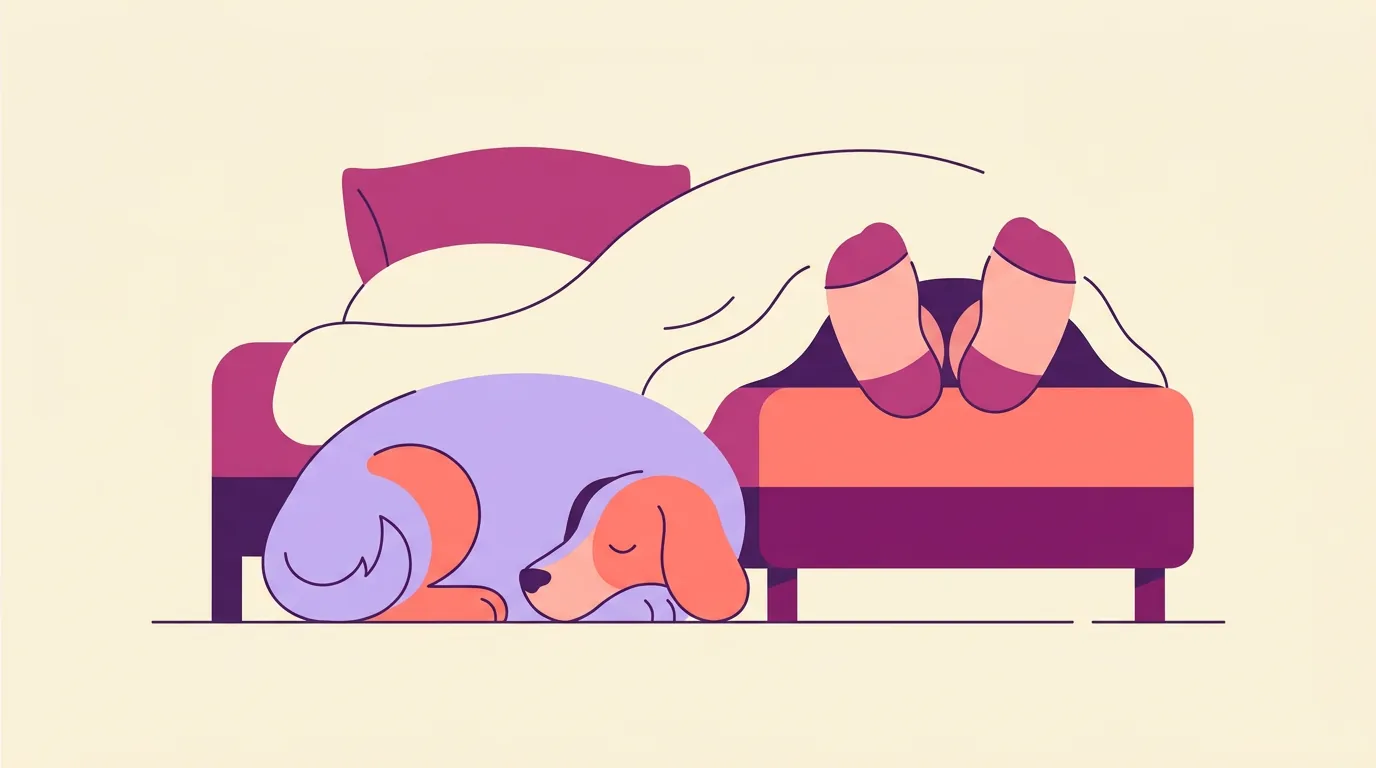
Why Does My Dog Sleep at My Feet? Loyalty, Warmth & the Pack
Your dog could sleep anywhere, but they pick your feet. It’s loyalty, security, and a little bodyguard instinct rolled into one.
Why Does My Dog Bark in His Sleep? Inside Doggy Dreams
Muffled woofs, paddling paws, twitchy whiskers — your dog is dreaming. Here’s what’s going on in there.
Why Does My Dog Yawn So Much?
Your dog yawns way more than seems sleepy — because for dogs, yawning is also communication. Here’s how.
Why Does My Dog Bury Bones?
The cartoon-classic bone burial is real instinct — a built-in pantry strategy from your dog’s wild past.