 🐶 Dog Mystery
The short answer
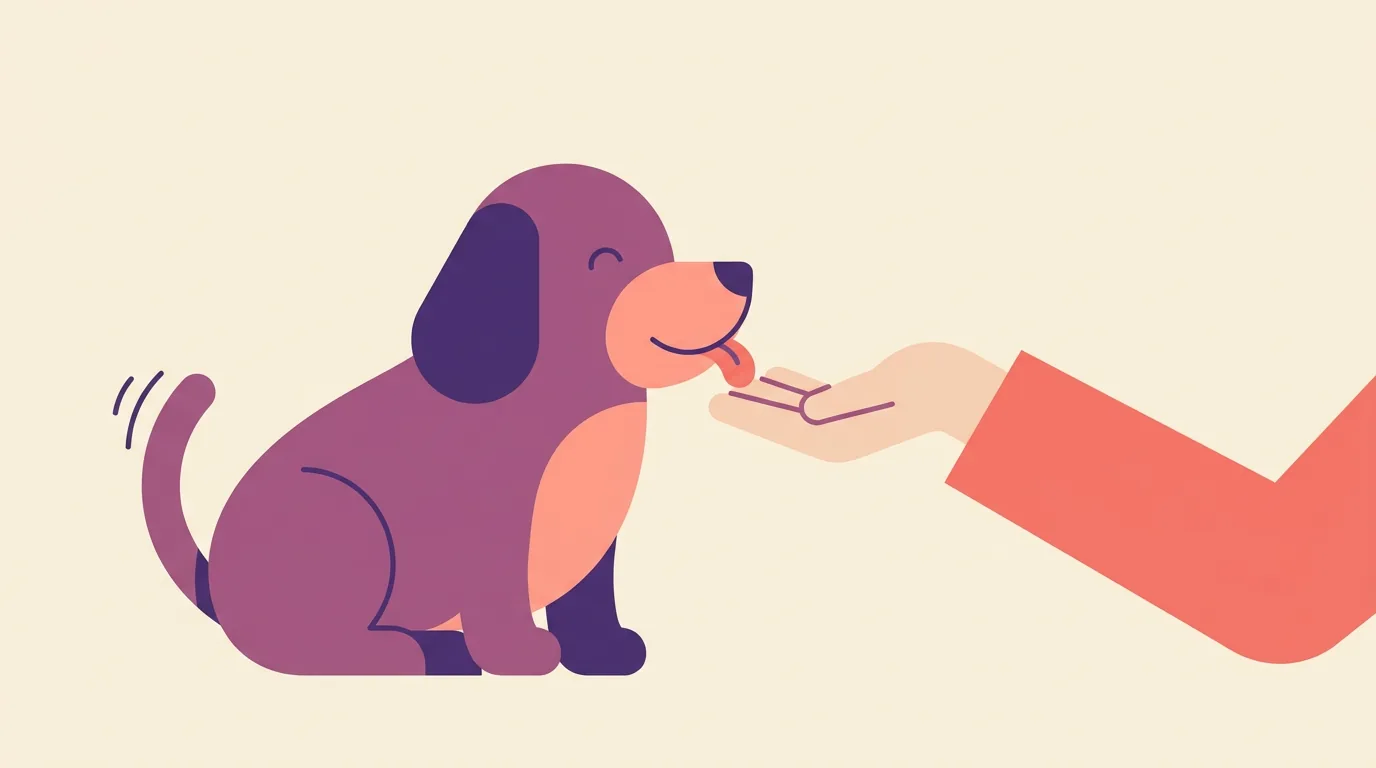
Hand-licking is affection, grooming, and information-gathering — your hands carry salt, scents, and a ton of data about where you’ve been. It’s also a learned attention-getter and a calming, endorphin-releasing habit.
Hands are the part of you a dog interacts with most and the part that carries the most information. Hand-licking is so ordinary that it barely registers — which is exactly why the version that matters is easy to miss.
Your hands are an information feed
Hands touch everything: food, other animals, door handles, other people. They also sweat, and that sweat carries salt along with a chemical signature that changes with what you have eaten, how you have exerted yourself, and to some extent how you feel.
Dogs possess a vomeronasal organ that detects chemical signals ordinary smell does not pick up, and licking is the most direct way to deliver compounds to it. A dog licking your hand after you have been out is reading where you have been.
The social reasons
- Affection and bonding. Licking releases endorphins in the dog, making it self-reinforcing as well as social. It traces back to maternal licking from birth.
- Greeting. Hands are at the right height for a dog that cannot reach your face, so hand-licking often substitutes for the face-greeting ritual inherited from wild canids.
- Appeasement. Licking is a deferent, tension-reducing signal between dogs. A dog licking a stranger's outstretched hand is often managing its own uncertainty rather than expressing affection.
- Attention. Hand-licking reliably produces a response — stroking, talking, looking down. It gets repeated because it works.
- Taste. Salt after exercise, hand cream, or whatever you last ate. Frequently the whole explanation.
The one to watch for
There is a specific pattern worth separating out: a dog that licks hands persistently, obsessively, and cannot easily be interrupted.
Veterinary behaviour guidance is clear that excessive licking can indicate anxiety, boredom or pain rather than affection. A dog that licks your hands as a way of self-soothing — because licking releases endorphins — is using it the way some dogs use pacing or chewing, and the underlying state is what needs attention rather than the licking itself.
The distinguishing features are intensity and interruptibility. Relaxed hand-licking is brief, loose and easily redirected. Compulsive licking is sustained, hard to stop, resumes immediately, and often comes with other signs — pacing, panting without exertion, difficulty settling, or licking that transfers to the dog's own paws when hands are unavailable.
A quick test
Move your hand away and offer something else — a chew, a puzzle, a short training exercise. A dog licking for social or attention reasons will readily switch. A dog that ignores the alternative, returns immediately, and cannot settle is telling you the licking is serving a different function. That distinction is worth bringing to your vet.
Hygiene
Low risk for a healthy adult. Wash your hands before eating and before touching your face, do not allow licking of cuts, scratches or broken skin, and keep your dog's parasite prevention up to date.
Be more careful if you are immunosuppressed, pregnant, elderly, or managing diabetes — dog saliva carries bacteria including Capnocytophaga, which is uncommon but can cause serious illness in people with reduced immunity or without a functioning spleen. Hands that are about to prepare food should be washed regardless.
If you want it to stop
The mechanics are the same as with any attention-maintained behaviour. Do not push the dog away — that is contact, and contact is often read as engagement. Simply move your hand out of reach and disengage briefly, then reward an alternative.
The most effective alternative is usually a trained hand-target: teaching the dog to touch your palm with its nose and then be rewarded. It uses the same impulse to interact with your hand, gives it a clear beginning and end, and is far easier to live with than trying to suppress licking entirely.
Worth a vet visit
Book an appointment if hand-licking is new and intense, if it is hard to interrupt or resumes immediately every time, if it comes with pacing, panting without exertion, difficulty settling or distress when left alone, or if your dog has also started licking its own paws, the floor or furniture. That last combination in particular is worth investigating, as excessive licking of surfaces is frequently linked to gastrointestinal discomfort rather than behaviour.
Gear that actually helps
Hand-picked for this behavior. We may earn a small commission — at no cost to you.
Frequently asked
Why does my dog lick my hands?
Hands carry salt and a dense chemical signature about where you have been, and dogs have a vomeronasal organ that reads such signals — licking delivers them to it. Affection, greeting, appeasement and attention-seeking all contribute too.
Does hand licking mean my dog loves me?
Usually it indicates social connection and comfort — licking traces back to maternal care and releases endorphins. But it can also be appeasement from an uncertain dog, or simple attention-seeking, so read the body language alongside it.
When is hand licking a problem?
When it is sustained, hard to interrupt and resumes immediately. Excessive licking can indicate anxiety, boredom or pain rather than affection, especially alongside pacing, panting without exertion or difficulty settling.
Is it hygienic to let my dog lick my hands?
Low risk for a healthy adult. Wash before eating or touching your face, never allow licking of cuts or broken skin, and keep parasite prevention current. Be more cautious if you are immunosuppressed, pregnant, elderly or diabetic.
How do I stop my dog licking my hands?
Move your hand out of reach and disengage rather than pushing, which reads as contact. Then teach a hand-target — the dog touches your palm with its nose and is rewarded. It redirects the same impulse into something with a clear start and finish.
My dog licks my hands and also the floor and furniture. Is that different?
Yes, and it is worth raising with your vet. Excessive licking of surfaces has been strongly linked to gastrointestinal disorders rather than behaviour, so that combination should prompt a medical work-up rather than behaviour management alone.
Sources
Every claim on this page is checked against published veterinary and animal-behaviour research. Here’s where it comes from.
- 1Why do dogs lick humans? — VCA Animal Hospitals
- 2Why Does My Dog Lick Me? Why Do Dogs Lick People? — American Kennel Club
- 3Compulsive Disorders in Dogs — VCA Animal Hospitals
Keep exploring
Why Does My Dog Lick His Paws So Much?
A quick clean is fine, but nonstop paw-licking is your dog telling you something’s wrong. Here’s how to decode it.
Why Does My Dog Lick the Floor?
Your dog treats the kitchen floor like a plate. Usually it’s crumbs — but sometimes it’s a clue. Here’s how to tell.
 🐶 Dog Mystery
Why Does My Dog Lick My Face? Kisses, Instinct & Hygiene
Are they really “kisses”? Mostly yes — with a dash of instinct and a taste for your skin. Here’s what’s behind the face baths.
 🐶 Dog Mystery
Why Does My Dog Lick My Feet? (It’s Weirder — and Sweeter — Than You Think)
Gross? Maybe. But your dog licking your feet is a surprisingly meaningful mix of love, curiosity, and salt. Here’s the breakdown.
 🐶 Dog Mystery
Why Does My Dog Lick Everything? Curiosity, Boredom or a Red Flag?
Floors, walls, the air, you — when your dog licks everything in sight, here’s how to tell harmless habit from a health clue.
 🐶 Dog Mystery
Why Does My Dog Lean on Me? The Quiet Way Dogs Say “I Love You”
When your dog presses their whole body against your legs, it’s not random — it’s one of the most touching things they do. Here’s why.