 🐶 Dog Mystery
The short answer
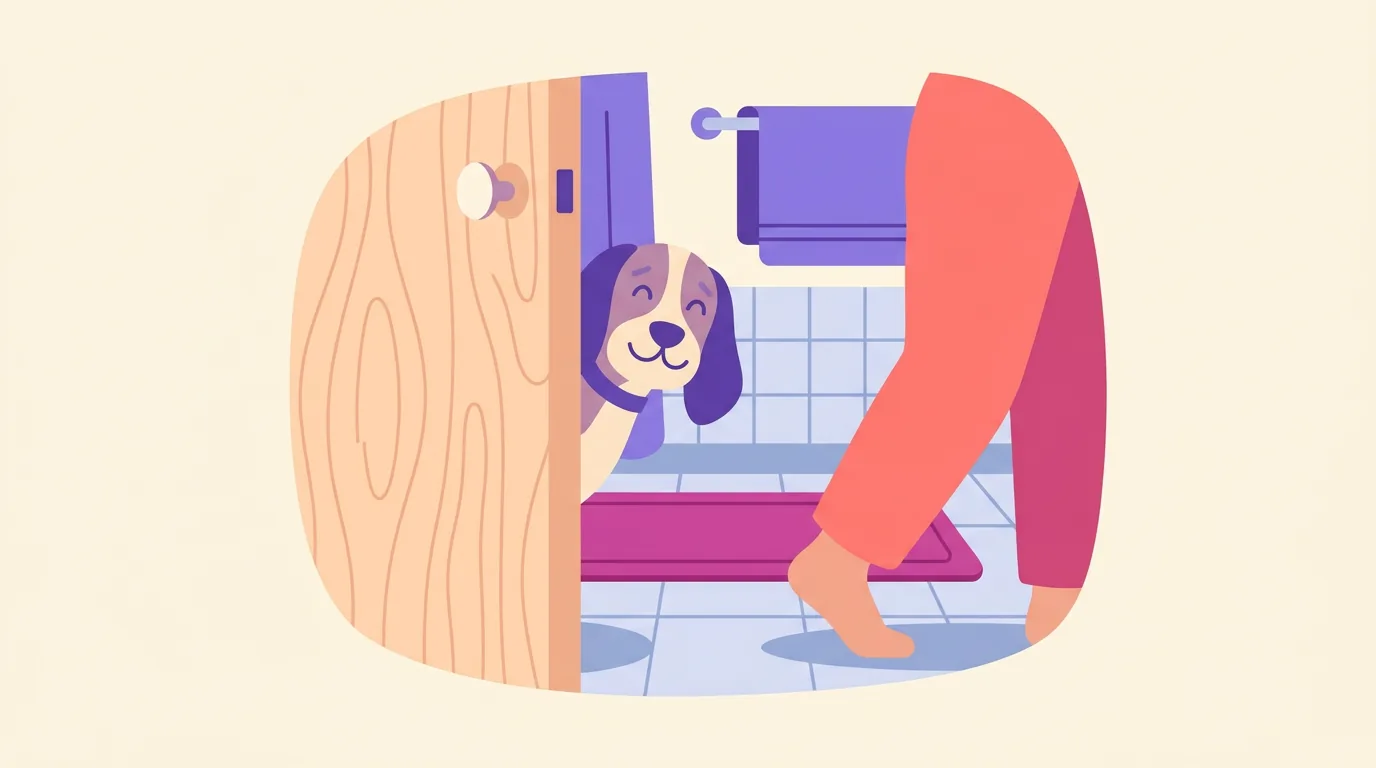
Your dog follows you to the bathroom because they’re a pack animal who wants to stay with you — there’s no privacy in a pack! It’s loyalty, bonding, and curiosity, and sometimes mild separation anxiety or simple habit.
It is the most universally reported dog behaviour there is, and the explanation is genuinely simple: your dog does not know the bathroom is different. There is no privacy convention in dog social life, and a closed door is an obstacle rather than a signal.
Dogs do not have a concept of privacy
Social canids do essentially everything in company. There is no behavioural category in dog life equivalent to 'this is the bit you do alone', so there is nothing for a dog to respect. From your dog's point of view you simply walked into a small room, and it followed as it would into any other.
The AKC's framing of dog-following is that it is baseline social behaviour with genetic roots — dogs were selected over thousands of years for close orientation to humans. Following is not a decision your dog makes; independence is the thing that has to be learned.
Why the bathroom specifically feels more intense
- You are stationary. Most of the day you move around and the dog tracks you. In the bathroom you stop, which makes you approachable and available in a way you usually are not.
- The room is small. Proximity is easy and unavoidable, which suits a contact-seeking animal.
- There is a door. Closed doors are aversive to social animals, and a door that sometimes shuts is a reliable way to make a dog want to be on the other side of it.
- The scent is concentrated. Bathrooms carry a lot of information about you, and dogs read chemical information the way we read text.
- Water is interesting. Running taps, showers and toilets are genuinely engaging to many dogs.
- It has been reinforced. Following you in has produced attention, or at minimum has never produced anything bad.
The bit that is actually worth knowing
Bathroom-following is normal and needs no fixing. What it can occasionally reveal is something else — because the bathroom is often the only moment in a day when a person deliberately separates from their dog.
If your dog scratches at the door, whines persistently, or becomes visibly distressed during those two minutes, that is a small-scale version of a bigger question: can your dog cope with being apart from you at all?
Veterinary sources describe separation anxiety as dogs that are overly attached and become extremely anxious when separated. Most such dogs follow their owners room to room — the following is a marker rather than the disorder. The disorder shows up in your absence: sustained vocalising, destruction focused on doors and exits, or house soiling in an otherwise reliably trained dog.
The bathroom door is a free training opportunity
It is the ideal micro-separation: short, predictable and repeated daily. Close the door for ten seconds and come back before there is any distress, then gradually extend. A dog that learns you reliably reappear is a dog that does not need to monitor you. If your dog already panics at ten seconds, that is useful information — and worth raising with your vet rather than working through alone.
If you want privacy
Consistency is the whole answer. A door that is closed on some days and open on others teaches persistence, because intermittent access is the most durable reinforcement schedule there is.
Pick one rule and keep it. If the dog stays out, give it something worth doing on the other side — a chew or a stuffed toy handed over before you go in works far better than shutting the door on a dog with nothing to do.
When following is worth investigating
Signals that need attention
Get a check if following became sudden and intense in a dog that was previously independent; if your dog cannot be alone without vocalising, destruction near exits, drooling, pacing or house soiling; or if it comes with disorientation, disturbed sleep, or a change in hearing or vision. Dogs seek proximity when in pain or when their senses decline, and separation anxiety responds well to structured desensitisation but poorly to being ignored or punished.
For everything else: this is one of the clearest signs that your dog considers you its social group, delivered in the least dignified setting available. It does not need solving.
Gear that actually helps
Hand-picked for this behavior. We may earn a small commission — at no cost to you.
Frequently asked
Why does my dog follow me to the bathroom?
Dogs have no concept of privacy — social canids do everything in company, so there is no category in dog life for 'the bit you do alone'. Add that you are stationary, the room is small, the scent is concentrated and there is a door, and it becomes the most followed room in the house.
Is it a problem that my dog follows me everywhere?
Not on its own. Following is baseline social behaviour selected for over thousands of years. What matters is whether your dog can also be apart from you — the concern is distress in your absence, not the following itself.
My dog whines and scratches at the bathroom door. Is that separation anxiety?
It can be an early indicator. Separation anxiety shows as sustained vocalising, destruction focused on doors and exits, or house soiling in an otherwise trained dog when alone. If your dog panics at even a few seconds of separation, raise it with your vet.
How do I get privacy in the bathroom?
Pick one rule and never vary it. A door closed on some days and open on others teaches persistence, because intermittent access is the most durable reinforcement schedule there is. Give the dog a chew before you go in rather than just shutting the door.
Can I use the bathroom door as training?
Yes, it is close to ideal — short, predictable, repeated daily. Close it for ten seconds and return before any distress, then extend gradually. A dog that learns you reliably reappear stops needing to monitor you.
Why does my dog stare at me while I'm in there?
You are stationary and available, which is unusual. Dogs also watch their people to predict what happens next, and in a small room with nothing else going on, you are the most interesting thing present.
Sources
Every claim on this page is checked against published veterinary and animal-behaviour research. Here’s where it comes from.
- 1Why Does My Dog Follow Me Everywhere? It's in Their Genes — American Kennel Club
- 2Separation Anxiety in Dogs — VCA Animal Hospitals
- 3Separation Anxiety — ASPCA
Keep exploring
 🐶 Dog Mystery
Why Does My Dog Follow Me Everywhere? The “Velcro Dog” Explained
Your dog is your shadow — even on bathroom trips. Mostly it’s love, with one thing worth watching for.
 🐶 Dog Mystery
Why Does My Dog Sleep at My Feet? Loyalty, Warmth & the Pack
Your dog could sleep anywhere, but they pick your feet. It’s loyalty, security, and a little bodyguard instinct rolled into one.
Why Does My Cat Follow Me to the Bathroom?
No privacy with a cat in the house. Here’s why the bathroom always comes with a feline chaperone.
Why Does My Dog Yawn So Much?
Your dog yawns way more than seems sleepy — because for dogs, yawning is also communication. Here’s how.
Why Does My Dog Lick His Paws So Much?
A quick clean is fine, but nonstop paw-licking is your dog telling you something’s wrong. Here’s how to decode it.
Why Does My Dog Lick the Floor?
Your dog treats the kitchen floor like a plate. Usually it’s crumbs — but sometimes it’s a clue. Here’s how to tell.