Why Does My Dog Follow Me Everywhere? The “Velcro Dog” Explained
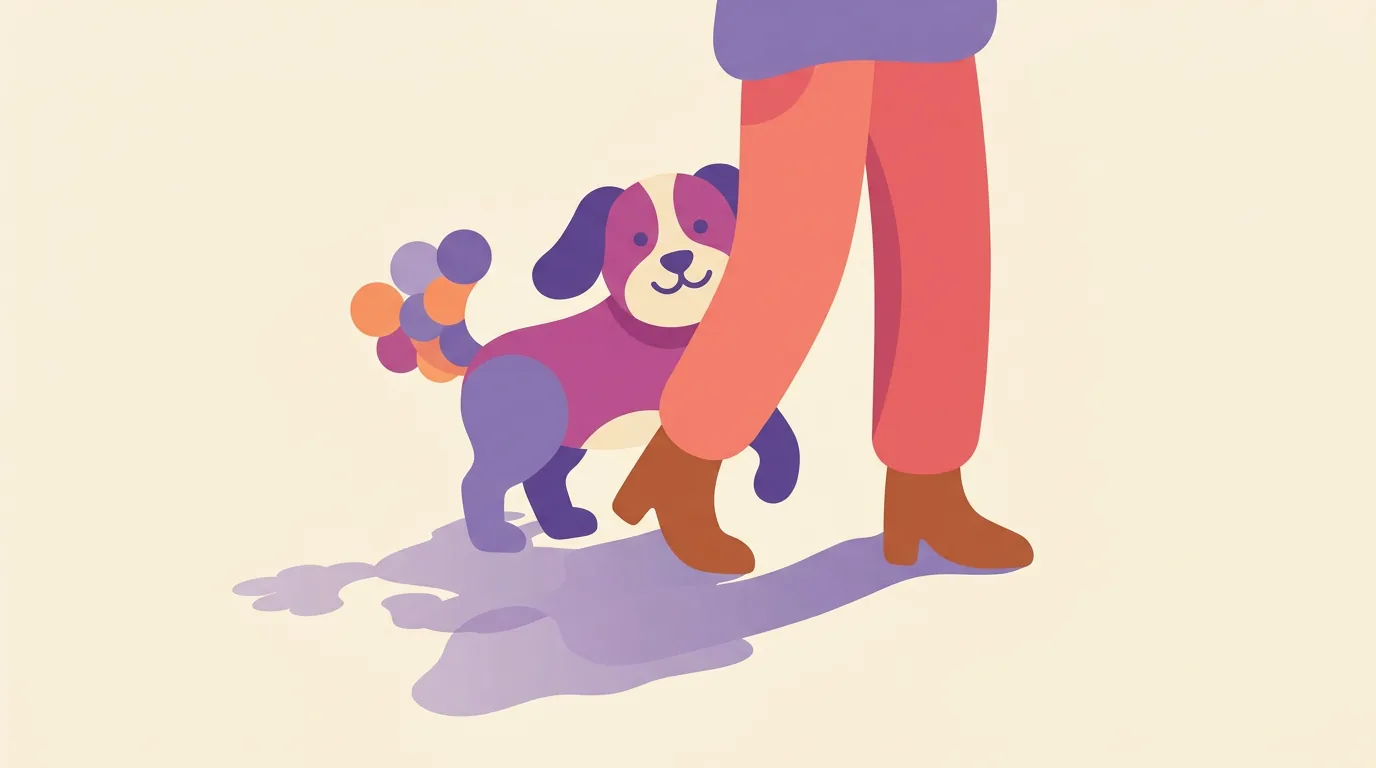 🐶 Dog Mystery
The short answer
Dogs are pack animals, so following you is natural — it’s bonding, your role as their leader and provider, curiosity, and learned reinforcement. “Velcro dog” behavior is usually sweet, but can tip into separation anxiety.
A dog that shadows you from room to room, including into the bathroom, is doing something entirely normal for a social species that was bred for thousands of years to work alongside people. The question worth answering is not why dogs follow — it is whether your dog can also cope with not following.
Why following is the default
Dogs are obligate social animals. In free-ranging groups they rest together, travel together and monitor each other constantly, and domestication amplified that orientation toward humans specifically. Following is the baseline behaviour; independence is the thing that has to be learned.
The everyday drivers stack on top of that:
- You are the source of everything. Food, walks, doors, play, attention and access to the outside world all originate with you. Watching you is efficient.
- Reinforcement history. Following has, over your dog's whole life, occasionally produced something good. That is enough to maintain it indefinitely.
- Breed. Herding and companion breeds were selected for close, continuous handler orientation. A Border Collie or a Cavalier following you is doing its job.
- Boredom. An under-stimulated dog follows because there is nothing else on offer. This one is common and fixable.
- Adolescence and old age. Adolescent dogs often become clingier for a period, and older dogs may follow more as hearing and vision decline and proximity becomes reassuring.
Normal shadowing versus separation anxiety
This is the distinction that actually matters, and following alone does not settle it. Plenty of perfectly well-adjusted dogs are shadows. The diagnostic question is what happens when you leave.
Veterinary sources describe separation anxiety as dogs that are overly attached or dependent on family members and become extremely anxious when separated from them. Critically, most dogs with separation anxiety try to remain close to their owners and follow them from room to room — but the following is a marker, not the disorder. The disorder is the distress in your absence.
The three signs classically associated with it are:
- 1Excessive vocalisation when alone — howling, barking or whining that continues rather than settling.
- 2Destructive behaviour, characteristically focused around exit points: doors, door frames, window sills.
- 3Inappropriate elimination in your absence, in a dog that is otherwise reliably house-trained.
Other markers include drooling, pacing, refusing food while alone, and an excessively enthusiastic greeting on your return with persistent demands for contact. If none of that is happening — if your dog follows you all day but settles calmly when you go out — you have a companionable dog, not a clinical problem.
Test it before you worry
Set up a phone or an old tablet recording the room where your dog stays, then leave for twenty minutes and watch it back. Most owners are reassured: the dog watches the door for two minutes and then sleeps. If instead you see pacing, howling, drooling or scratching at the door that does not settle, you now have concrete evidence to bring to your vet — and video is far more useful than a description.
If it is separation anxiety
The goal is not to teach the dog that following is wrong. It is to resolve the underlying anxiety by teaching the dog to tolerate, and ideally enjoy, being alone — by arranging things so it experiences being alone without fear in the first place.
That means working below the threshold at which panic starts: separations so short they produce no distress at all, gradually extended only while the dog stays relaxed. Departure cues get uncoupled too — picking up keys, putting on shoes and opening the door are practised without leaving, until they stop predicting absence.
This is genuinely slow work, usually weeks to months, and it is one of the areas where professional help pays for itself. For severe cases, medication alongside behaviour modification is well established and worth discussing with your vet rather than treating as a last resort.
What makes it worse
Do not punish the vocalising, destruction or soiling — it happens because the dog is panicking, and punishment adds fear to an already fearful situation. Do not use a crate as a fix unless the dog is genuinely happy in one, as confinement often intensifies panic and dogs can injure themselves trying to escape. And do not get a second dog to solve it: separation anxiety in dogs is usually about a specific person, and another dog rarely resolves it.
If it is just boredom or habit
For the ordinary version, the fix is enrichment plus a settle. More physical exercise helps, but mental work helps more — sniffing walks where the dog is allowed to stop and investigate, food puzzles, scatter feeding, and short training sessions all tire a dog far more effectively than another lap of the block.
Then teach a genuine off-switch. Reward your dog for lying on a mat or bed at a distance from you, building duration slowly, so there is a well-paid alternative to standing at your feet. And build independence deliberately in small doses: step behind a door for ten seconds, come back before there is any distress, repeat. A dog that has learned that you always come back is a dog that does not need to monitor you.
Gear that actually helps
Hand-picked for this behavior. We may earn a small commission — at no cost to you.
Frequently asked
Why does my dog follow me everywhere?
Dogs are an obligate social species selected over thousands of years for close orientation to people, so following is the default rather than something unusual. On top of that you control food, walks, doors and attention. Breed, boredom, adolescence and declining senses in older dogs all increase it.
Is my dog following me a sign of separation anxiety?
Not on its own — plenty of well-adjusted dogs are shadows. What matters is what happens when you leave. Separation anxiety is marked by excessive vocalisation, destruction focused around exits, and house soiling in an otherwise trained dog while alone.
How can I tell if my dog is distressed when I leave?
Record twenty minutes on a phone or tablet and watch it back. Most dogs watch the door briefly then sleep. Pacing, howling, drooling or scratching at the door that does not settle is evidence of a real problem — and the video is far more useful to your vet than a description.
Should I stop my dog from following me?
There is no need if your dog settles calmly when alone. If you would like more space, teach a positive alternative — rewarding a settle on a mat at a distance — rather than shutting the dog out, which tends to increase rather than reduce the behaviour.
Will getting a second dog help?
Usually not. Separation anxiety in dogs is typically about separation from a specific person, so another dog rarely resolves it and you may end up managing two dogs' needs instead of one.
Why does my dog follow me into the bathroom?
Because there is no reason in dog logic not to. Dogs do not share our privacy conventions, closed doors are aversive to a social animal that wants to stay with its group, and you being stationary in a small room is a good opportunity for attention.
Sources
Every claim on this page is checked against published veterinary and animal-behaviour research. Here’s where it comes from.
- 1Separation Anxiety in Dogs — VCA Animal Hospitals
- 2Separation Anxiety — ASPCA
Keep exploring
 🐱 Cat Mystery
Why Does My Cat Follow Me Everywhere? Inside the “Velcro Cat”
Bathroom, kitchen, back again — your shadow has whiskers. Here’s why your cat can’t seem to let you out of sight.
 🐶 Dog Mystery
Why Does My Dog Follow Me to the Bathroom? No Privacy in a Pack
Closed doors are no match for a devoted dog. Here’s why your bathroom has a furry chaperone.
 🐶 Dog Mystery
Why Does My Dog Tilt His Head? The Adorable Mystery, Explained
It might be the most photogenic thing dogs do — and there’s real science (plus a little showmanship) behind that tilt.
Why Does My Dog Eat Poop? The Gross Habit, Explained (and Fixed)
It’s revolting, it’s common, and it’s usually fixable. Here’s why dogs do it — and how to make it stop.
Why Does My Dog Yawn So Much?
Your dog yawns way more than seems sleepy — because for dogs, yawning is also communication. Here’s how.
Why Does My Dog Lick His Paws So Much?
A quick clean is fine, but nonstop paw-licking is your dog telling you something’s wrong. Here’s how to decode it.