 🐱 Cat Mystery
The short answer
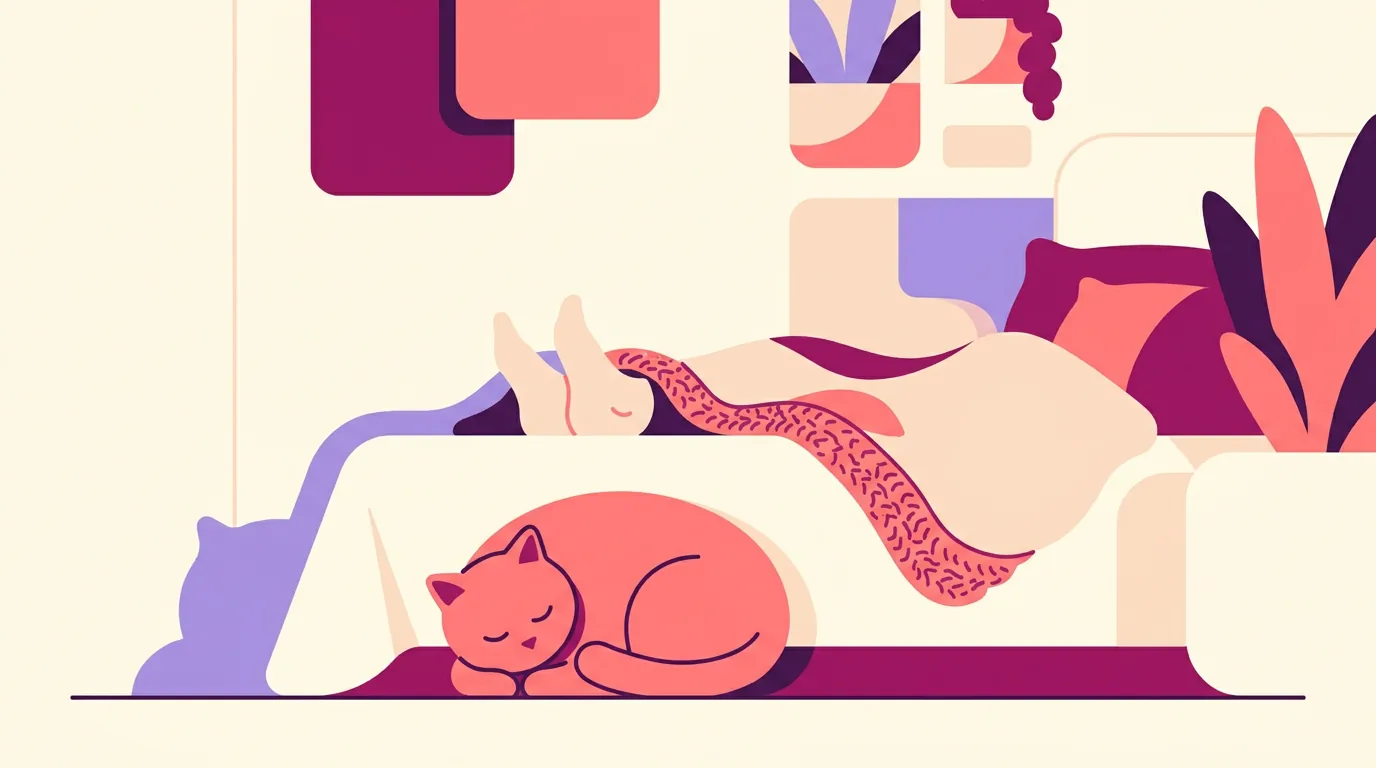
Sleeping at your feet lets your cat stay close and bonded while keeping a bit of independence and an easy escape route. Your warmth, your scent, and the safety of your presence make your feet the perfect compromise spot.
A cat at the foot of the bed is making a different choice from one on your pillow, and it is worth reading correctly. Foot-of-the-bed is not a lesser form of affection — it is usually a cat balancing two competing priorities at once.
Close enough to matter, far enough to escape
Cats sleep in a state of readiness that we do not. Even a deeply relaxed cat keeps an exit strategy, and where it sleeps is chosen partly on how quickly it could leave.
The foot of the bed is the compromise position. It gives contact with the group — the thing feline social bonds are actually built on — while keeping a clear route off the bed and a view of the door. A cat there is choosing companionship without giving up its exit, which is entirely characteristic of the species.
You move less down there
The practical reason is more mundane. Your torso and arms shift constantly during the night; your feet move far less and over a smaller area. For a cat that wants uninterrupted sleep, the lower third of the bed is simply the calmer end.
This is why some cats migrate over the course of a night — arriving on your chest while you are still awake and relocating to your feet once you are properly asleep and rolling over. The behaviour is often read as rejection. It is closer to seat selection.
Warmth, weight and guarding
- Warmth. Duvets trap heat around the legs and feet, so that end of the bed is often the warmest part of the covers — as opposed to your head, which is the warmest exposed part.
- Weight distribution. Cats prefer a firm surface for sleeping. The tucked end of a duvet is usually flatter and better supported than the middle.
- The doorway view. Many cats orient toward the room entrance while sleeping. The foot of the bed usually offers the better line of sight.
- Territory. Your bed carries the strongest concentration of your scent in the house, and a cat sleeping on it is folding itself into that shared scent profile.
The old claim that a cat at your feet is 'guarding' you is popular and not well supported. Cats do not run protective watch behaviour the way the story implies. Position choice is better explained by warmth, stability and escape routes.
If your cat wakes you at 4am
The position is rarely the problem; the timing is. Cats are crepuscular and a cat that has slept through an empty house all day arrives at dawn with energy to spend. A genuine wand-toy play session until the cat is actually tired, followed immediately by the largest meal of the day, shifts the cycle far more effectively than moving the cat. A timed feeder set for early morning removes the incentive to wake you for breakfast.
What it says about your relationship
Research on cat social structure consistently finds that proximity — simply choosing to be near someone — is the main currency of feline relationships, rather than the overt greeting displays other species use. Sleeping on your bed at all is the meaningful part. Which end is mostly logistics.
It is also worth knowing that cats often pick the household member who moves least and is most predictable at night rather than the one who gives the most attention during the day. If your cat sleeps on someone else's feet, that is usually about sleep quality, not preference.
When to pay attention
Changes worth a vet appointment
A cat that has always slept on the bed and stops, or one that starts sleeping unusually far away or in odd hidden locations, is worth investigating — cats commonly withdraw when in pain or unwell. Equally, a cat that becomes suddenly insistent on close contact, especially with night vocalising, weight loss, increased thirst or disorientation, should be seen. In older cats, hyperthyroidism, arthritis, high blood pressure and cognitive dysfunction all change sleeping habits, and all are worth catching early.
Difficulty jumping onto the bed is its own signal. Cats rarely limp visibly with arthritis; instead they stop doing things. A cat that used to sleep on the bed and now sleeps on a chair may not have changed its mind — it may have stopped being able to make the jump comfortably. A set of steps or a lower platform is worth trying, alongside a conversation with your vet about pain relief.
Gear that actually helps
Hand-picked for this behavior. We may earn a small commission — at no cost to you.
Frequently asked
Why does my cat sleep at my feet instead of next to me?
It is a compromise position: close enough for the contact that feline social bonds are built on, far enough to keep a clear exit and a view of the door. Practically, your feet also move far less through the night than your torso and arms.
Does sleeping at my feet mean my cat is less bonded to me?
No. Research on cat social structure finds proximity itself is the main currency of feline relationships. Choosing to sleep on your bed at all is the meaningful part — which end is mostly about warmth, stability and escape routes.
Is my cat guarding me while I sleep?
Probably not. That idea is popular but not well supported — cats do not run protective watch behaviour the way the story implies. Position choice is better explained by warmth, a stable surface and a clear line of sight to the door.
Why does my cat move from my chest to my feet during the night?
Usually seat selection rather than rejection. Your chest is appealing while you are still and awake; once you are asleep and rolling over, the foot of the bed becomes the calmer, more stable end.
My cat stopped sleeping on the bed. Should I worry?
It is worth checking. Cats withdraw when in pain or unwell, and a cat that has stopped jumping onto the bed may be finding the jump uncomfortable rather than choosing to sleep elsewhere. Arthritis is common and under-diagnosed in cats — try steps or a lower platform and speak to your vet.
Why does my cat sleep on my partner's feet and not mine?
Usually because they move less at night. Cats tend to pick the most predictable, stable sleeper rather than the person who gives the most attention during the day.
Sources
Every claim on this page is checked against published veterinary and animal-behaviour research. Here’s where it comes from.
- 1Social organization in the cat: a modern understanding — Journal of Feline Medicine and Surgery (via PubMed Central)
- 2Influence of familiarity and relatedness on proximity and allogrooming in domestic cats — Curtis, Knowles & Crowell-Davis, via PubMed
- 3The Special Needs of the Senior Cat — Cornell Feline Health Center
Keep exploring
 🐱 Cat Mystery
Why Does My Cat Sleep on My Head? The Pillow Thief, Explained
You wake up wearing a cat hat. Again. Here’s why your head is your cat’s favorite mattress.
Why Does My Cat Sleep on My Pillow?
Your cat has claimed your pillow as their own. It’s a bigger compliment than it seems.
Why Does My Cat Stare at Me While I Sleep?
You wake up to two eyes locked on you. Creepy? Actually, it’s mostly love (and breakfast hopes).
Why Does My Cat Sleep in Weird Positions?
Folded like a pretzel or sprawled belly-up — your cat’s weird sleep poses actually mean something.
Why Does My Cat Knead Blankets? Making Biscuits, Explained
Paws pressing rhythmically into a soft blanket — “making biscuits.” It’s pure cozy instinct. Here’s why.
Why Is My Cat Clingy All of a Sudden? Sweet Shift or Red Flag?
Your independent cat suddenly won’t leave your side. Sweet — but worth understanding, because the cause matters.