 🐱 Cat Mystery
The short answer
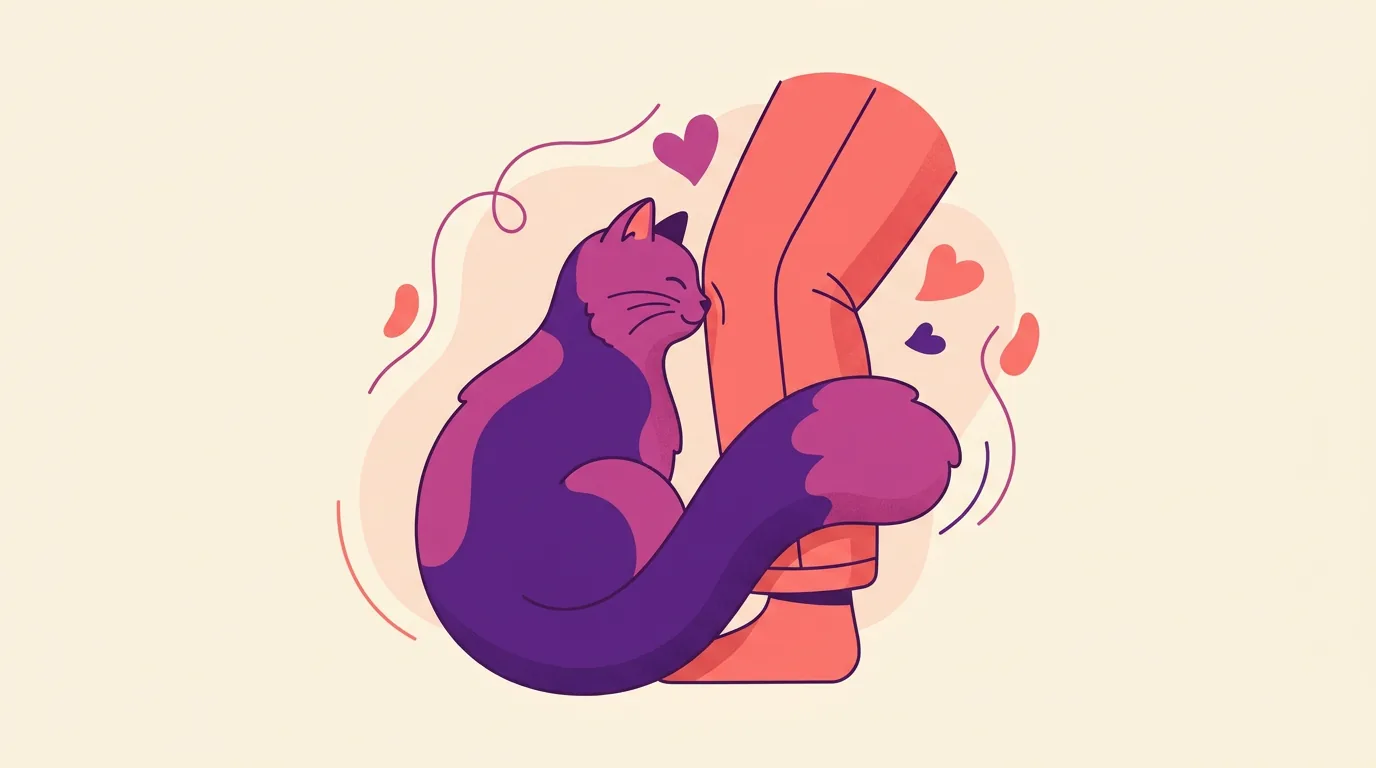
Rubbing against you (“bunting” with the body) deposits your cat’s scent from glands in their cheeks and flanks, marking you as safe and “theirs.” It’s a friendly greeting, a bond-builder, and often a polite request for attention.
The figure-of-eight wind around your ankles is so routine that most owners never ask what it is for. It is doing three jobs at once, and only one of them is what people assume.
It is scent work, first
Cats carry scent glands in the cheeks, the chin, the forehead, the base of the tail and the paw pads. They do not mark territory the way dogs do — they build a shared group odour, and they treat everything carrying it as safe. Research on feline social structure describes proximity and scent exchange as the main currency of cat relationships, which is why so much cat affection is delivered by pressing a gland against you rather than by anything we would recognise as a display.
When your cat slides its cheek, flank and finally the base of its tail along your leg, it is running glands along you in sequence. The behaviour is called allorubbing when directed at another cat, and it is one of the core affiliative behaviours in the feline repertoire.
The purpose is a shared profile. Cats that live together rub each other, sleep in contact and groom each other, and the result is a group smell that identifies who belongs. Rubbing you writes you into it — and picks up your scent in return, which is the part owners rarely realise.
It is also a greeting
Between cats, allorubbing concentrates around reunions — after separation, on returning to a shared resting area. That maps neatly onto what happens when you come home.
It has a hierarchy element too, though not the one people expect: in free-living groups, smaller or lower-status cats tend to rub larger ones more often than the reverse. Applied to a household, the rubbing is a friendly, deferential greeting rather than a claim over you.
And it is frequently a request
The third job is the practical one. If the rubbing happens at consistent times, ends with the cat walking toward the kitchen, or intensifies when you open a cupboard, it is a request that has been reinforced hundreds of times.
Owners often report that their cat is 'affectionate only at dinner time', usually with some disappointment. Both things are true at once: the behaviour is genuinely affiliative in origin and it has also been learned as an effective way to produce food. Cats are not being insincere; they are being efficient.
Where the glands are
If you want to give a rubbing cat what it is actually asking for, target the gland areas: the cheeks, under the chin, the base of the ears and along the forehead. Those are the spots cats present when they rub, and the ones other cats groom. The base of the tail is more variable and the belly is a common trigger for overstimulation — sticking to the head and neck avoids most nips.
Reading the whole cat
Relaxed rubbing comes with an upright tail, often with a slight hook at the tip, a loose body, slow movement and sometimes a chirp or trill. The upright tail is worth knowing on its own — it is one of the clearest friendly-approach signals cats have, and it is close to unique to domestic cats among felids.
Rubbing with a low, tucked or bristled tail, flattened ears or a tense body is a different animal — that is an anxious cat seeking reassurance rather than a confident one greeting you.
When it changes
Worth a vet appointment
See a vet if rubbing becomes sudden and relentless, especially in a cat over seven and alongside increased vocalisation, weight loss, increased thirst or urination, or restlessness — hyperthyroidism presents this way and is diagnosed with a simple blood test. Also check if your cat rubs one side of its face persistently, tilts its head, or scratches at an ear, which suggests ear disease or dental pain rather than social behaviour. And a cat that stops rubbing altogether is telling you something too, since withdrawal from social contact is a common early sign of illness in cats.
Gear that actually helps
Hand-picked for this behavior. We may earn a small commission — at no cost to you.
Frequently asked
Why does my cat rub against my legs?
It is running scent glands along you — cheek, flank and tail base in sequence. Cats build a shared group odour rather than marking territory, so rubbing writes you into the group profile and picks up your scent in return. It is also a greeting and often a request.
Is my cat marking me as its property?
Not in the ownership sense people mean. Cats do not mark territory the way dogs do — they create a shared scent profile and treat everything carrying it as safe. It is inclusion rather than possession.
Why does my cat only rub against me at feeding time?
Both things are true at once: the behaviour is genuinely affiliative in origin, and it has also been learned as a very effective way to produce food. Cats are not being insincere, just efficient.
What does the upright tail mean when my cat rubs me?
It is one of the clearest friendly-approach signals cats have, and close to unique to domestic cats among felids. An upright tail with a slight hook at the tip, a loose body and a chirp or trill means a relaxed, confident greeting.
Where should I pet a cat that rubs against me?
The gland areas it is presenting: cheeks, under the chin, base of the ears and forehead. The tail base is more variable and the belly is a common overstimulation trigger — sticking to the head and neck avoids most nips.
My cat rubs one side of its face constantly. Is that normal?
Persistent one-sided face rubbing is worth checking. It suggests ear disease or dental pain rather than social behaviour, especially alongside head-tilting or scratching at an ear.
Sources
Every claim on this page is checked against published veterinary and animal-behaviour research. Here’s where it comes from.
- 1Social organization in the cat: a modern understanding — Journal of Feline Medicine and Surgery (via PubMed Central)
- 2Influence of familiarity and relatedness on proximity and allogrooming in domestic cats — Curtis, Knowles & Crowell-Davis, via PubMed
Keep exploring
Why Does My Cat Follow Me to the Bathroom?
No privacy with a cat in the house. Here’s why the bathroom always comes with a feline chaperone.
Why Does My Cat Lay on My Clothes?
Fresh laundry, worn hoodie, it doesn’t matter — your cat will claim it. Here’s the cozy reason why.
Why Does My Cat Sleep on My Pillow?
Your cat has claimed your pillow as their own. It’s a bigger compliment than it seems.
Why Does My Cat Lick the Wall?
Tongue to the wall? It’s odd but common — and here’s how to tell harmless curiosity from a red flag.
Why Does My Cat Chatter at Birds?
Window open, bird outside, and your cat goes “ek-ek-ek.” Here’s what that funny chatter really means.
Why Does My Cat Get the Zoomies at Night?
Midnight sprints across the furniture? It’s normal cat biology — and very fixable. Here’s how.