 🐱 Cat Mystery
The short answer
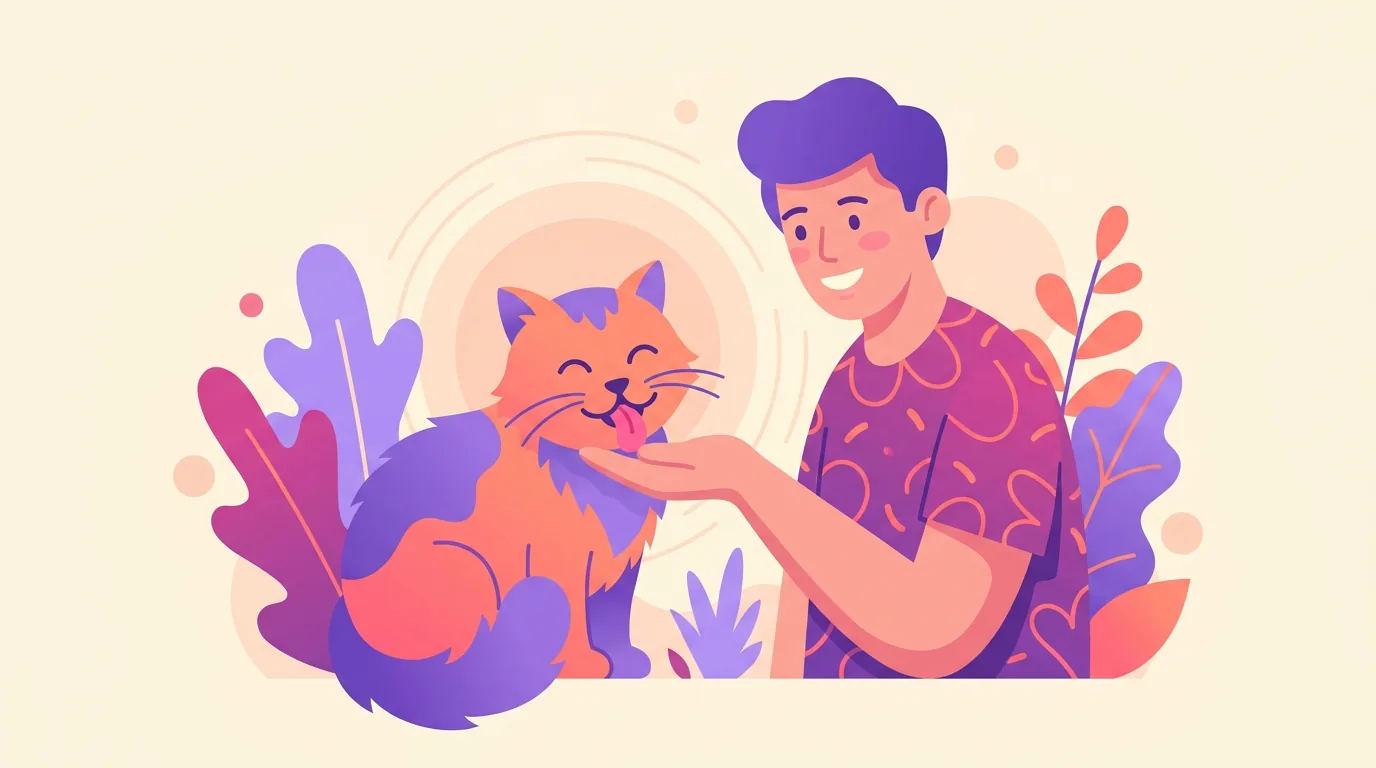
When your cat grooms you — licking your skin or hair — they’re treating you as part of their family group (allogrooming), strengthening your bond, sharing scent, and showing deep trust and affection.
Being groomed by a cat is one of the clearer statements it can make about your status in its social world — but the research on what grooming actually does between cats is more complicated than the standard reading, and worth knowing.
Allogrooming is relationship management
Cats groom themselves constantly and efficiently. Grooming someone else is a different behaviour with a different function, called allogrooming, and it is one of the few things in the feline repertoire that exists purely to manage social relationships.
It is not distributed randomly. Research on feline social behaviour finds allogrooming concentrated within stable groups, aimed mostly at the head and neck — the areas an individual cannot reach alone — and appearing far more between cats that are related or have lived together a long time than between strangers.
A cat grooming you has already filed you as in-group. That part of the standard reading holds up.
The 2026 finding that complicates it
Researchers at Ghent University and the University of Lincoln ran a citizen-science study across 53 two-cat households, analysing video of real grooming rather than relying on owner recall, and published it in Applied Animal Behaviour Science.
Two results matter. Seeking physical contact was followed by allogrooming in a large share of cases, supporting the bonding interpretation. But a substantial minority of grooming bouts were followed by agonistic behaviour from the groomer — a threat display, a stiffening, a swat.
So allogrooming also functions to manage tension: sometimes appeasement, sometimes a quiet assertion of status. Applied to you, this does not mean your cat is hostile. It means grooming is relationship maintenance rather than a simple affection signal — and it explains the pattern owners find most confusing, where a grooming session turns into a bite with no obvious warning.
Why the tongue feels like that
The roughness comes from papillae, backward-facing keratin spines that act as a comb: they strip loose fur, carry saliva down to the skin and pull meat from bone. They are built for fur, which is why they feel abrasive on bare skin.
It is also why cats target hair, eyebrows and arm hair preferentially — those are the closest things you have to a coat, and the head and neck are exactly where cats direct grooming at each other.
When grooming turns to teeth
Two mechanisms overlap. First, cats groom each other with teeth as well as tongue — small nibbles are a normal part of the sequence between cats, and your skin simply registers them differently than fur does.
Second, overstimulation. Repetitive contact builds arousal, and past a threshold a relaxed cat flips to irritated. Veterinary behaviour resources call this petting-induced aggression and it is one of the most commonly reported feline behaviour issues.
The signals come two to five seconds early
Before almost every nip: the tail starts to lash or thump, the skin along the back twitches, the ears rotate backward, the pupils widen, and the purring stops or changes pitch. Move your arm calmly at the first of those rather than the last. Going still works better than pulling away sharply, which triggers the grab reflex.
Should you let your cat groom you?
For a healthy adult with intact skin, the risk is low. Wash the area before eating, do not allow grooming of broken skin or wounds, and be more cautious if you are immunosuppressed, pregnant, very young or very old.
If you would rather not, redirect rather than refuse — offer a hand instead of a face, or slide a soft blanket under the cat. Pushing a cat away mid-groom rejects the clearest signal it has that it considers you family, and most cats simply try again shortly after.
When grooming is a symptom
Book a vet appointment if the grooming of you is new and relentless, if it is hard to interrupt, or — most importantly — if your cat is also over-grooming its own coat and producing bald patches, scabs or hair loss on the belly, flanks or inner legs. Compulsive grooming in cats is far more often driven by stress, pain or skin disease than by temperament, and it is much easier to treat early.
Gear that actually helps
Hand-picked for this behavior. We may earn a small commission — at no cost to you.
Frequently asked
Why does my cat groom me?
Allogrooming is one of the few feline behaviours that exists purely to manage relationships. It is concentrated within stable groups, aimed at heads and necks, and appears far more between cats that are related or long-cohabiting than between strangers — so a cat grooming you has filed you as in-group.
Does grooming always mean affection?
Not purely. A 2026 video study of 53 two-cat households found a substantial minority of grooming bouts were followed by threat behaviour from the groomer, meaning allogrooming also manages tension. Treat it as relationship maintenance rather than a simple affection signal.
Why does my cat's tongue feel so rough?
It is covered in papillae — backward-facing keratin spines that strip loose fur, move saliva to the skin and pull meat from bone. They are designed for fur, which is why they feel abrasive on bare skin.
Why does my cat groom me then bite?
Cats normally combine tongue and teeth when grooming each other, so nibbling is part of the sequence. Overstimulation adds to it — repeated contact builds arousal until a relaxed cat becomes irritated. Watch the tail, back skin and ears and stop before the nip.
Is it hygienic to let my cat groom me?
For a healthy adult with intact skin the risk is low. Wash before eating, never allow grooming of broken skin or wounds, and be more cautious if immunosuppressed, pregnant, very young or very old.
When should grooming worry me?
If it is new and relentless or hard to interrupt, and especially if your cat is also over-grooming its own coat to bald patches, scabs or hair loss. Compulsive grooming usually reflects stress, pain or skin disease rather than temperament.
Sources
Every claim on this page is checked against published veterinary and animal-behaviour research. Here’s where it comes from.
- 1Unravelling feline social dynamics — a video-based observational study on allogrooming in domestic cats — Van Belle et al., Applied Animal Behaviour Science (2026)
- 2Social organization in the cat: a modern understanding — Journal of Feline Medicine and Surgery (via PubMed Central)
- 3Influence of familiarity and relatedness on proximity and allogrooming in domestic cats — Curtis, Knowles & Crowell-Davis, via PubMed
Keep exploring
Why Does My Cat Follow Me to the Bathroom?
No privacy with a cat in the house. Here’s why the bathroom always comes with a feline chaperone.
Why Does My Cat Lay on My Clothes?
Fresh laundry, worn hoodie, it doesn’t matter — your cat will claim it. Here’s the cozy reason why.
Why Does My Cat Sleep on My Pillow?
Your cat has claimed your pillow as their own. It’s a bigger compliment than it seems.
Why Does My Cat Lick the Wall?
Tongue to the wall? It’s odd but common — and here’s how to tell harmless curiosity from a red flag.
Why Does My Cat Chatter at Birds?
Window open, bird outside, and your cat goes “ek-ek-ek.” Here’s what that funny chatter really means.
Why Does My Cat Get the Zoomies at Night?
Midnight sprints across the furniture? It’s normal cat biology — and very fixable. Here’s how.